Services
Twelve services, sold together or separately, and a table that tells you which of the acronyms you actually need. Every engagement starts with the audit, because that is how we price the rest honestly.
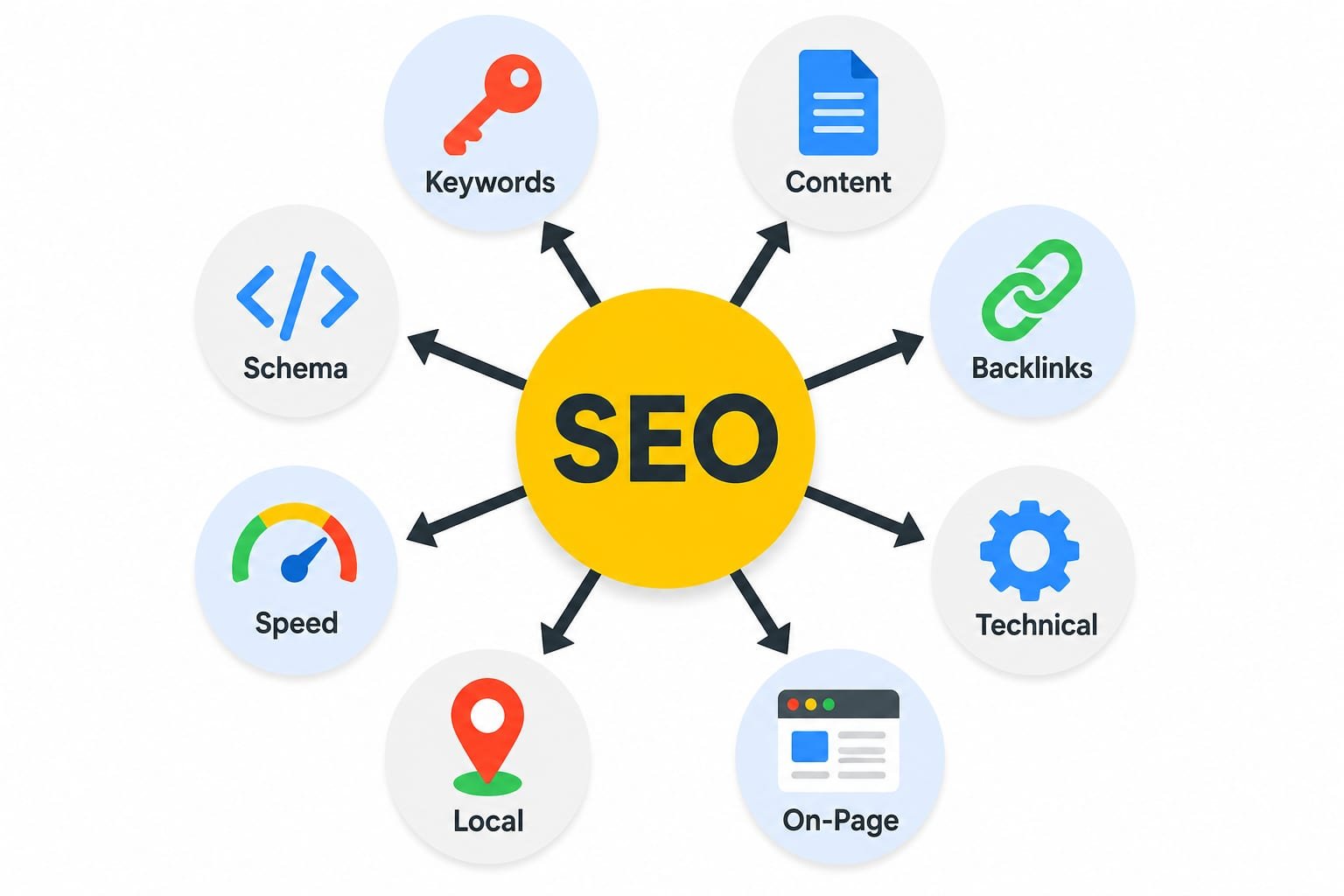
What we do
-
SEO services
Fixed-price audit, then a monthly sprint or retainer fee
The full programme. Technical, on-page, and links, sequenced from an audit and reported against pipeline.
For founders, owners, and marketing leads at companies of any size, from small businesses and local firms to SaaS, ecommerce, and professional services, who have been burned by an SEO vendor before or would like to skip that stage.
-
Link building
Per placement by tier, or a monthly campaign fee for digital PR
Earned links, disclosed sources, written anchor policy. No PBNs, no undisclosed paid placements.
For any company whose pages already deserve to rank and need authority to get there, and for agencies that want a link partner they can put in front of their own clients.
-
On-page SEO
Monthly fee based on page volume
Keyword mapping, briefs, rewrites, internal linking, and structured data, with your experts reviewing every page.
For any company whose product pages, category pages, service pages, or guides are indexed but sit on page two or three, or rank for queries that do not lead to a sale.
-
Technical SEO
Fixed-price audit; sprint fee or project fee for migrations
Crawl, index, render, and speed problems diagnosed and fixed, in code or in tickets. Migrations without losing rankings.
For any company on JavaScript frameworks, headless CMSs, e-commerce platforms, or ageing WordPress builds where the content is fine but Search Console keeps reporting problems nobody on the team can explain.
-
Local SEO
Inside the sprint or retainer, or a fixed local package for single locations
Google Business Profile, location pages, citations, and reviews run as one programme. Every action reported.
For clinics, law and accounting firms, trades, showrooms, restaurants, and any business with one or more physical locations whose customers search with a place in mind.
-
Ecommerce SEO
Sprint or retainer, sized by template count and SKU volume
Category and product templates, faceted navigation, feeds, and links for online stores, reported against revenue.
For online stores on Shopify, WooCommerce, Magento, BigCommerce, or a custom stack, with hundreds to hundreds of thousands of SKUs, whose category pages sit behind marketplaces and competitors.
-
Answer engine optimization (AEO)
Included in the sprint or retainer, or a standalone AEO programme
Get cited by ChatGPT, Perplexity, Google AI Overviews, and Copilot. Crawler access, answer-first pages, entity facts, earned mentions, monthly tracking.
For companies whose buyers now ask an AI assistant before they search, and for anyone who has watched organic clicks fall while impressions held steady.
-
Generative engine optimization (GEO)
Included in the sprint or retainer, or a standalone AI search programme
Get used as a source in Google AI Overviews, AI Mode, Gemini, and Copilot. Passage structure, fan-out coverage, freshness, and monthly inclusion tracking.
For companies whose Google traffic has fallen while impressions held, and for anyone who has searched their own category and found an AI summary sitting above the results they used to win.
-
AI SEO services
Priced as the SEO programme
One programme for search rankings and AI citations. AI used for research, log analysis, clustering, and QA; people write, decide, and review. Method disclosed.
For companies that want both kinds of visibility and that have been burned, or worry about being burned, by an agency that quietly swapped its writers for a chatbot.
-
AI optimization (AIO)
Included in the AI search programme, or a standalone AIO project plus monitoring
Entity and fact optimization across all AI systems. Knowledge sources, structured data, corroborating mentions, corrections, and a monthly record of what each assistant says about you.
For companies that have caught an assistant describing them wrongly, quoting an old price, or recommending a competitor for a job they do better, and for brands with several products whose facts have drifted across the web.
-
LLM optimization (LLMO)
Included in the AI search programme, or as a standalone LLMO project
Presence in what models learn and retrieve. Reference content, licensing and syndication, llms.txt, corpus-level mentions, and tracking across model versions.
For companies in categories where buyers ask an assistant for a shortlist and the assistant answers from memory, and for anyone who has found that a new model version knows their competitors and not them.
-
Search experience optimization (SXO)
Included in the sprint or retainer, or a standalone SXO project
Intent-to-page matching, landing page experience fixes, conversion tests, and reporting by leads and revenue per organic landing page.
For companies whose organic traffic is fine and whose organic leads are not, and for anyone who has ranked first for a term and wondered why nothing happened.
-
SEO audit
Fixed price, two weeks
The starting point for everything above. Technical, content, and link review with a ranked findings list and a 90-day roadmap.
For anyone deciding whether and where to invest in SEO, including people who then run it in-house.
Off-page SEO lives inside link building, because for most sites the two are the same work: earning references from other sites. Content SEO lives inside on-page SEO, because the brief, review, and linking process is identical whether the page is new or rewritten. Local SEO, ecommerce SEO, and search experience optimization have their own pages because each adds a layer (the Business Profile and citations; templates, facets, and feeds; intent matching and conversion measurement), and the AI search terms (AEO, GEO, AIO, LLMO, and AI SEO) have one page each because buyers search for them separately and each is measured differently, even though they share most of their inputs. All of them run on the same method. The methodology explains how the four fit together, and how pricing works shows what each costs.
SEO, AEO, GEO, AIO, LLMO, SXO: which do you need?
Seven acronyms, roughly two and a half disciplines. The four AI terms share most of their inputs and differ in target, unit of success, and clock; SEO is what they all depend on and SXO is what the traffic is for.
| Axis | SEO | AEO | GEO | AIO | LLMO | SXO |
|---|---|---|---|---|---|---|
| Stands for | Search engine optimization | Answer engine optimization | Generative engine optimization | AI optimization | Large language model optimization | Search experience optimization |
| Optimises | Pages | Passages | Passages and coverage | The entity (facts about you) | What the model holds | The visit after the click |
| Target system | Google, Bing | ChatGPT, Perplexity, Claude, Copilot | Google AI Overviews and AI Mode, Gemini | Any AI assistant, including ones with no search | The model's training and retrieval corpora | The landing page and the person on it |
| Unit of success | Rank and click | Citation in the answer | Inclusion as a source | Accurate description, appropriate recommendation | Correct answer with browsing off | Lead or sale from organic |
| Measured by | Rankings, sessions, conversions | Citation share per prompt set | Inclusion share; Overview-present clicks | Fact accuracy; share of recommendation | Fact accuracy and unprompted mentions per model version | Leads and revenue per landing page |
| Moves in | 3 to 6 months | 4 to 8 weeks once ranking | 4 to 8 weeks once ranking | 1 to 3 months for retrieved facts | Model release cycles | Weeks, per page |
| Depends on | Crawlable, relevant pages and links | SEO | SEO | Consistent facts everywhere | AIO plus open, stable, cited content | SEO traffic |
AI SEO is not a column because it is not a layer: it is the whole programme (SEO plus the AI layers) delivered with AI tools for the checkable work and named people for anything attributed to you, with the line disclosed in every report. See AI SEO services, or read the full comparison in SEO vs AEO vs GEO vs AIO vs LLMO vs SXO.
How an engagement runs
-
Audit
2 weeks
A fixed-scope technical, content, and link audit with a prioritised issue list and a forecast of what fixing it is worth.
-
Roadmap
1 week
A 90-day plan with owners, effort, and expected impact for every item. You can take it in-house or run it with us.
-
90-day sprint
3 months
We execute the roadmap with your team: fixes shipped, pages rewritten, links earned, reported every two weeks.
-
Retainer
Month to month
Continued work on the next tranche of opportunities. Cancel with 30 days notice; you keep everything we built.
What we will not do
- No guaranteed rankings or "page one" promises. Nobody can honestly offer them.
- No private blog networks, link farms, hacked links, or undisclosed paid placements.
- No mass-produced AI articles published without a named human editor.
- No engagements where SEO is the wrong channel for the business. We will say so in the audit.
Questions buyers ask
Can we buy one service without the others?
Yes. Link building and technical SEO are frequently bought alone. The audit still comes first, because we will not point links at pages that cannot rank or fix templates without knowing which pages matter.
How do you decide which services we need?
The audit ranks findings by impact and effort across technical, on-page, and links. The roadmap that follows tells you which services matter for your site, and it is not unusual for it to recommend leaving one out.
Do you work with e-commerce stores and local businesses as well as B2B?
Yes, and each has its own page. Ecommerce SEO covers faceted navigation, product templates, and feeds; local SEO covers the Google Business Profile, citations, and location pages. Both run on the same audit, roadmap, sprint, retainer method. Multilingual SEO is scoped case by case.
Do you offer AEO, GEO, AIO, or LLMO for AI search?
Yes, each has its own page because each targets a different system and is measured differently: AEO for conversational assistants, GEO for Google's AI Overviews and AI Mode, AIO for the facts every assistant holds about you, LLMO for what models know without searching. They share most of their inputs, so they are sold as one AI search programme, inside the sprint or standalone. The table on this page compares them.
What is SXO, and is it SEO?
Search experience optimization is SEO measured by what the visitor does after the click: intent match, page experience, and one clear next step, reported as leads and revenue per organic landing page. It runs inside the sprint or retainer, or as a standalone project for a defined set of pages.
Start with the audit.
Two weeks, fixed price, and a prioritised list you can act on with or without us. If SEO is not the right channel for you, the audit will say so.