Answer engine optimization (AEO) services: get cited where people ask, not only where they search
Your company named and linked when ChatGPT, Perplexity, Google's AI Overviews and AI Mode, Claude, or Copilot answer the questions your buyers ask, with monthly measurement of where you appear and where competitors do instead.
For companies whose buyers now ask an AI assistant before they search, and for anyone who has watched organic clicks fall while impressions held steady.
Updated
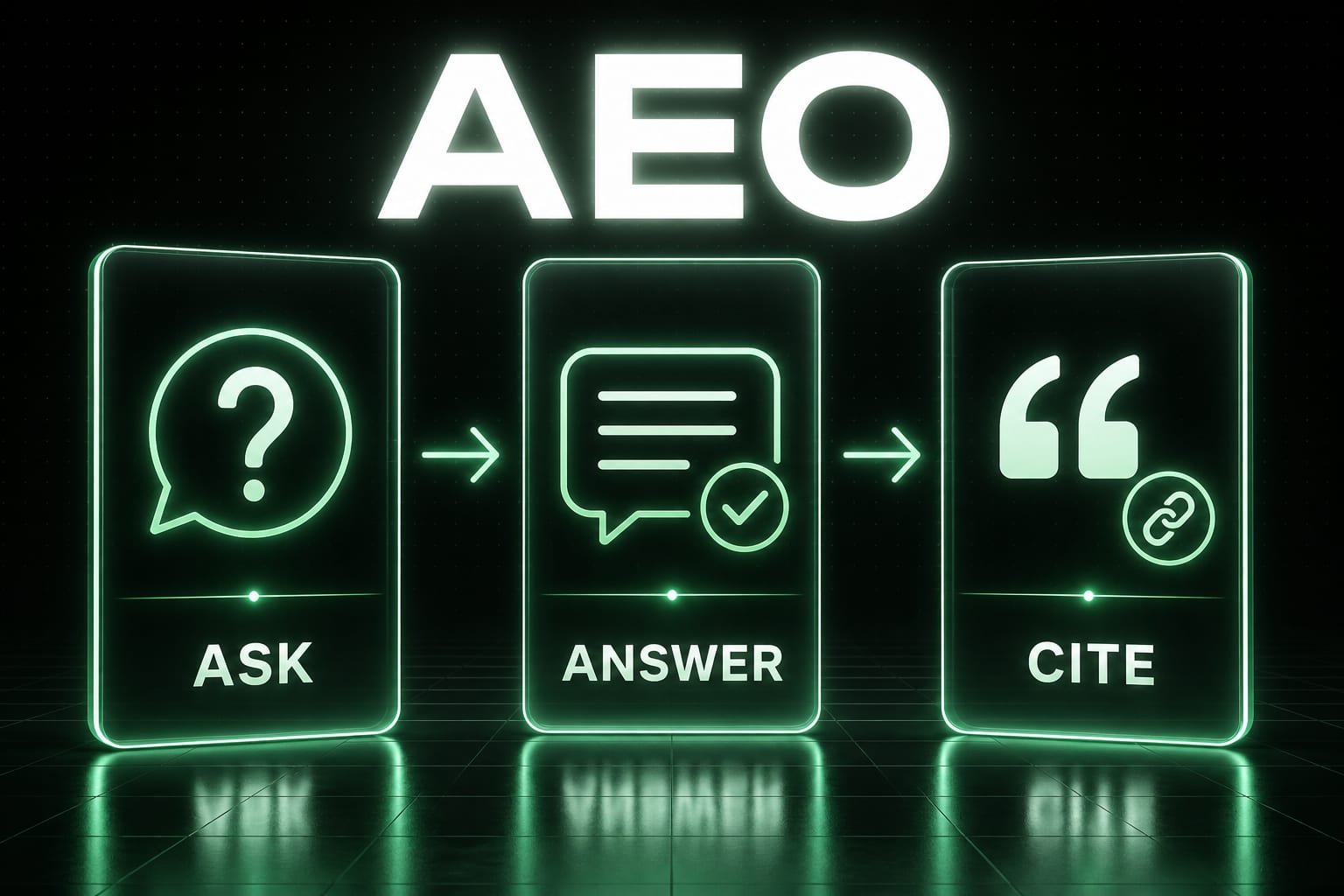
What are AEO services, and what is included?
Answer engine optimization (AEO) services make a company more likely to be named, quoted, and linked when an AI system answers a question, whether that is ChatGPT search, Perplexity, Google's AI Overviews and AI Mode, Claude, or Microsoft Copilot. The same work is sold as generative engine optimization (GEO) when the target is Google's AI features; the labels differ, the mechanics mostly do not. At Seorythm the service starts with an AI visibility audit: which of your buyers' questions each engine already answers, which sources it cites, whether your brand appears, and whether AI crawlers can even reach your pages. From there we fix access (robots rules, HTML-first content, llms.txt), restructure key pages into question-led sections with self-contained answer passages, make the facts about your company consistent everywhere an engine might read them (structured data, profiles, directories), earn mentions on the sources engines cite most in your category, and track a fixed set of prompts across engines every month. Reporting shows citations won and lost per prompt and per engine, next to the organic and referral traffic that followed.
What you get
| Deliverable | Cadence | What it includes |
|---|---|---|
| AI visibility audit | Weeks 1 to 2 | 40 to 80 buyer prompts run across ChatGPT, Perplexity, Google AI Overviews and AI Mode, Claude, and Copilot. Which engines answer, which sources they cite, where you and competitors appear. Crawler access and content structure check. |
| Access and technical fixes | Month 1 | robots.txt rules for AI crawlers, primary content in HTML rather than client-side rendering, llms.txt, dateModified and author markup, speakable passages. |
| Answer-first page restructuring | 4 to 8 pages per month | Question-led headings, one self-contained answer passage per question, definitions and comparisons stated plainly, FAQs aligned to the questions engines actually receive. |
| Entity and fact consistency | Month 1, quarterly check | Organization and Person structured data, the same name, description, prices, and claims across your site, profiles, directories, and review sites, corrections where engines state something wrong about you. |
| Citation-source mentions | Monthly target set in roadmap | Digital PR and outreach aimed at the publications, communities, and comparison sites each engine cites most in your category. Mentions count even without a link. |
| Prompt tracking and reporting | Monthly | The prompt set re-run across engines, citations won and lost, competitor share of citations, and the referral and organic traffic that followed. Tracked with Ahrefs Brand Radar plus manual sampling. |
How the work is done
Measure first, because nobody knows their AI visibility
Almost no company knows what ChatGPT or Perplexity says about it, or which competitor gets named when a buyer asks for a recommendation. The audit answers that. We build a set of 40 to 80 prompts from the questions your sales team hears, your support tickets, and your search data, run each across the engines several times, and record who is cited. The result is a map: questions where you already appear, questions where a competitor does, and questions where the engines cite a roundup or a forum thread that you could be in. That map sets the roadmap; nothing is restructured before it exists.
Access before anything else
Answer engines fetch pages with their own crawlers, most of which do not run JavaScript. If your primary content renders client-side, or your robots.txt blocks GPTBot and OAI-SearchBot, ClaudeBot, PerplexityBot, or Google-Extended, no amount of writing helps. We fix access first: crawler rules, HTML-first content, a plain-text llms.txt that describes the site, and dateModified and author markup so the engines can judge freshness and provenance. This is technical SEO work with a different list of user agents.
Write for the quote, not the scroll
An engine composes an answer from passages, not pages. A passage that can be lifted out and still be true, complete, and attributable is the unit we write for: a question as the heading, a direct answer in the first sentence, the supporting detail in the next few, no reference to “above” or “below”. Each key page gets at least two such passages, marked with speakable structured data, following Google’s published guidance on how content appears in AI features, plus FAQs aligned to the questions the engines actually receive rather than the ones we would like them to ask. This is on-page SEO with the answer moved to the front.
Facts that agree everywhere
Engines cross-check. If your site says one price, a directory says another, and a review site describes a product you discontinued, you are less likely to be cited and more likely to be described wrongly. We make the facts agree: Organization and Person structured data on your site, the same description on every profile and directory that matters, and a plain corrections page for anything an engine currently gets wrong about you. Where an engine offers a way to report inaccuracies, we use it and record the outcome.
Mentions where the engines read
Each engine has sources it leans on in each category: trade publications, comparison sites, community threads, sometimes Wikipedia (whose own entry on generative engine optimization is a fair summary of the field). The audit shows which, and we track citation share over time with Ahrefs Brand Radar alongside manual sampling. Our link building team then works those sources specifically, through digital PR, editorial outreach, and honest participation, because a mention there counts toward citation even when it carries no link. We do not seed threads under false names or buy reviews; both are detectable and both would put every other mention at risk.
AEO is one layer of our AI search programme, next to generative engine optimization for Google’s AI features and AI optimization for the facts assistants hold about you; the terms are compared in SEO vs AEO vs GEO vs AIO vs LLMO vs SXO. It sits on top of our SEO services programme, and it works because the layers under it are sound. Start with the audit, which now includes AI visibility, or see pricing for the standalone programme.
What it costs
Included in the sprint or retainer, or a standalone AEO programme
The AI visibility audit is part of the $2,800 audit. Ongoing AEO work runs inside the sprint or retainer for clients who buy the full programme, or as a standalone AEO programme at $1,200 to $4,000 a month, set 20% below The HOTH's published AI Discover tiers. The comparison is on the pricing page.
What moves the number
- Number of prompts tracked and engines covered
- How many pages need restructuring versus light edits
- Whether original data or expert content must be produced to be citable
- Mention acquisition volume in your category
Who this is not for
- Companies with no real product, reviews, or public footprint. Engines cite what other sources already describe; there is nothing to amplify yet.
- Anyone who wants us to post fake reviews, seed Reddit threads under false names, or manipulate Wikipedia. All three are detectable and all three we refuse.
- Buyers who expect a guaranteed citation for a given prompt. Model outputs vary between sessions; nobody can honestly promise a specific answer.
- Sites with unresolved technical or content problems. AEO is the last layer, and it is wasted on pages an engine cannot fetch or would not quote.
Risks and how we manage them
| Risk | How we manage it |
|---|---|
| An engine states something false about your company. | The audit records what each engine currently says. We fix the sources it drew on (your own pages first, then profiles and directories), publish a plain corrections page, and re-check monthly. Where an engine offers a feedback route, we use it. |
| Optimising for prompts nobody asks. | The prompt set is built from your sales conversations, support tickets, and search data, not from what we imagine buyers ask. It is reviewed quarterly and pruned. |
| Engines change how they retrieve and cite. | We build on the durable inputs (accessible pages, plain answers, consistent facts, real mentions) rather than on any engine's current quirk, and the monthly tracking shows a change within a cycle. |
| Measurement noise is mistaken for movement. | Each prompt is sampled several times per engine per month, and we report share of appearances, not single runs. Changes smaller than the noise band are labelled as such. |
What is the difference between AEO and SEO?
SEO earns a ranking: a position in a list of links for a query, where the click is the reward. AEO earns a citation: being one of the handful of sources an AI system draws on and names when it composes an answer, where the reward is being mentioned, linked, or recommended inside the answer itself. The inputs overlap heavily. Answer engines retrieve pages through the same crawling and indexing that search uses, and they prefer the same things: pages that answer a specific question plainly, named authors, consistent facts, and references from other sites. The differences are in emphasis. AEO cares more about self-contained passages that survive being quoted out of context, about entity consistency (does every source describe your company the same way), about mentions on sites the models trust even when those mentions carry no link, and about measurement, because there is no rank tracker for a conversation. A site that does SEO well is most of the way to AEO; AEO on a site with unfixed technical or content problems does not work.
Questions buyers ask
Is AEO worth it?
If your buyers ask AI assistants questions you could be the answer to, yes, and increasingly so as AI Overviews and AI Mode take clicks that used to reach organic results. It is not worth buying separately if your site still has technical or content problems; fix those first, because the same work carries most of the AEO benefit. The audit tells you which situation you are in.
What is an example of AEO?
A buyer asks Perplexity "which SEO agencies publish their prices?" Today it cites two roundup articles and one agency page. The agency page is cited because it states the prices in plain text near a question-form heading, carries Offer structured data, and is mentioned in the roundups. AEO is doing those three things deliberately, for the questions that matter to you, then checking monthly that the citation held.
Is generative engine optimization a real thing, or a rebrand of SEO?
Both. Most of GEO or AEO is SEO done properly: crawlable pages, clear answers, consistent facts, earned references. What is new is the unit of success (a citation, not a rank), the weight on unlinked mentions, and the need to measure by sampling prompts across several engines. Anyone selling it as unrelated to SEO is selling you the SEO twice.
How much does AEO or GEO cost?
The AI visibility audit is included in our $2,800 audit. Ongoing work runs inside the sprint ($4,800 to $7,400 a month) or retainer, or as a standalone AEO programme at $1,200 to $4,000 a month depending on prompts tracked, pages restructured, and mention volume. Each figure is 20% below the comparable published price; the comparison is on the pricing page.
Can you guarantee we will appear in ChatGPT or Google's AI Overviews?
No, and nobody can. Outputs vary between sessions and engines change retrieval without notice. What we can do is make you the easiest credible source to cite for a defined set of questions, measure how often that happens, and show you the trend.
Do you use AI to write the content for this?
For research, prompt sampling, and QA, yes. Pages are written or rewritten by a named person and reviewed by your expert, because engines increasingly discount generic text and the corrections page in particular has to be exactly right.
Start with the audit.
Two weeks, fixed price, and a prioritised list you can act on with or without us. If SEO is not the right channel for you, the audit will say so.