Seven acronyms are now used to sell roughly two and a half disciplines. Some of the terms describe genuinely different work with different targets and different clocks. Some are the same work sold under the label a buyer happens to search for. This post sets them side by side on three axes (what system is being optimised, what counts as success, and how long it takes to move) so that you can read a proposal and know what is actually being offered.
We sell all seven, so we have an interest in you buying some of them. We have tried to write this the way we would want to read it before doing so.
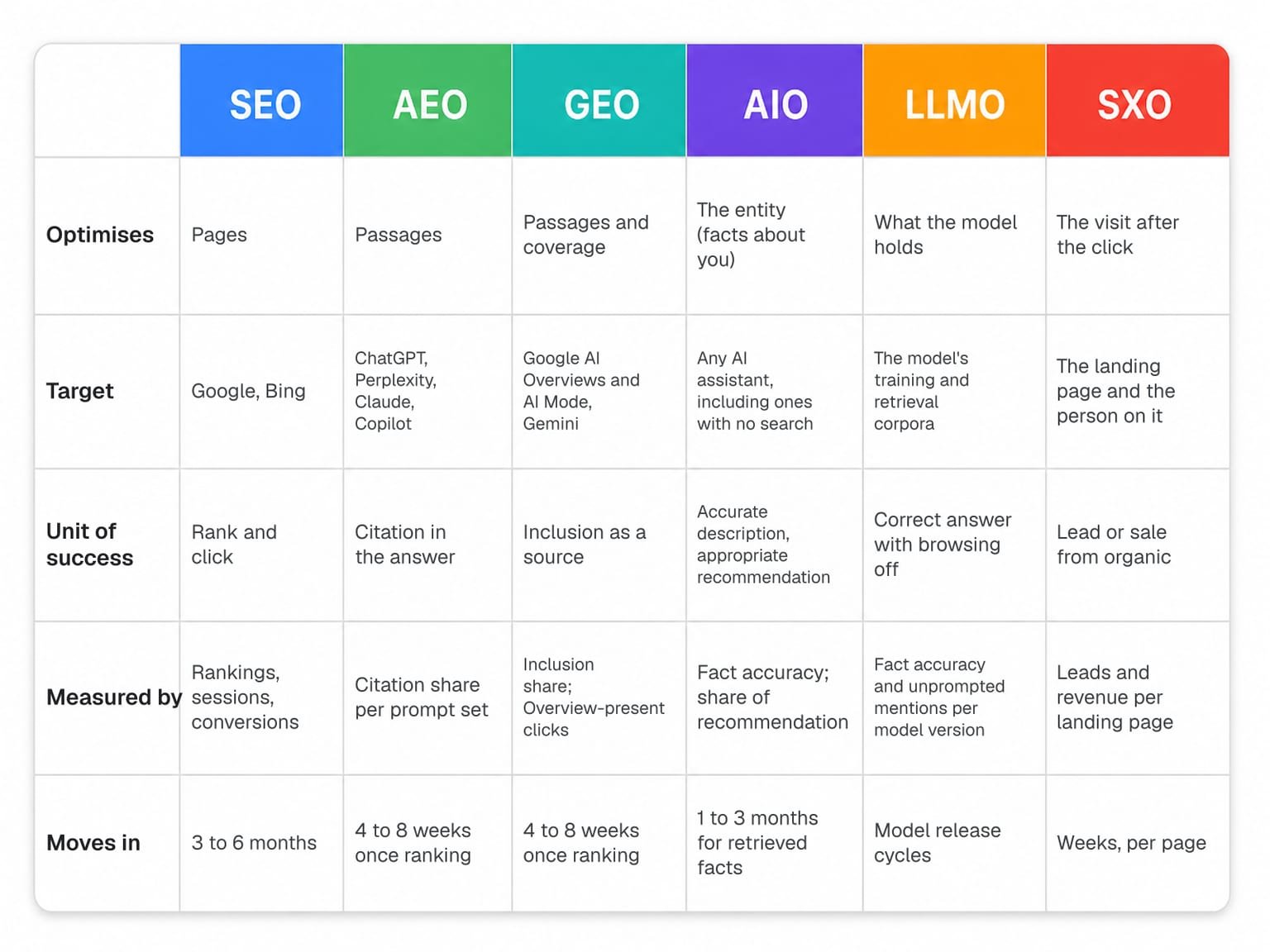
The one-table version
| SEO | AEO | GEO | AIO | LLMO | SXO | |
|---|---|---|---|---|---|---|
| Stands for | Search engine optimization | Answer engine optimization | Generative engine optimization | AI optimization | Large language model optimization | Search experience optimization |
| Optimises | Pages | Passages | Passages and coverage | The entity (facts about you) | What the model holds | The visit after the click |
| Target system | Google, Bing | ChatGPT, Perplexity, Claude, Copilot | Google AI Overviews and AI Mode, Gemini | Any AI assistant, including ones with no search | The model’s training and retrieval corpora | The landing page and the person on it |
| Unit of success | Rank and click | Citation in the answer | Inclusion as a source | Accurate description, appropriate recommendation | Correct answer with browsing off | Lead or sale from organic |
| Measured by | Rankings, sessions, conversions | Citation share per prompt set | Inclusion share; Overview-present clicks | Fact accuracy; share of recommendation | Fact accuracy and unprompted mentions per model version | Leads and revenue per landing page |
| Moves in | 3 to 6 months | 4 to 8 weeks once ranking | 4 to 8 weeks once ranking | 1 to 3 months for retrieved facts | Model release cycles | Weeks, per page |
| Depends on | Crawlable, relevant pages and links | SEO | SEO | Consistent facts everywhere | AIO plus open, stable, cited content | SEO traffic |
AI SEO is not a column because it is not a layer. It is the whole programme, classic SEO plus the AI layers, delivered with AI tools in the workflow. It gets its own section below.
SEO, search engine optimization
SEO is the base everything else stands on, and it has not changed as much as the acronyms suggest. It makes pages crawlable and fast, matches each page to the intent of the queries it should rank for, structures the content so a search engine can understand it, and earns references from other sites so the engine trusts it. Success is a rank, and behind the rank a click, a session, and a conversion. It moves in months, because rankings are earned against competitors doing the same work.
What the AI era changed is not the work but its consequences. The same crawlable, plain, well-referenced page that ranks is the page a generative engine retrieves and quotes. Our SEO services page covers the programme; technical SEO and on-page SEO cover the parts everything else depends on.
AEO, answer engine optimization
AEO makes a company more likely to be named, quoted, and linked when a conversational assistant answers a question: ChatGPT with search, Perplexity, Claude, Microsoft Copilot. The unit of success is a citation, not a rank. Because the assistant composes an answer from passages, the work concentrates on passages that survive being lifted out of the page (question as heading, direct answer first, specific detail after, no “see above”), on facts that agree everywhere the assistant might read, on access for the assistants’ crawlers, and on mentions on the sources each assistant leans on in your category, which count even without a link.
It moves in weeks for pages that already rank, because the assistants re-fetch ranking pages often. It does nothing for pages that do not rank, because the assistants retrieve from the same index. Measurement is by sampling: a fixed prompt set run across engines monthly, with citation share reported as a rate. Details on the AEO service page.
GEO, generative engine optimization
GEO is the term most used for Google’s generative features (AI Overviews and AI Mode) and for Gemini, and it is also the name of the research lineage, starting with a 2023 paper, that tested which content changes raised a source’s visibility in generated answers. Those experiments found that adding statistics, quoting named sources, and citing references helped, and keyword stuffing did not.
The mechanism that makes GEO slightly different from AEO is query fan-out. For one prompt, Google’s AI Mode runs several searches, one per implied sub-question, and builds the answer from the top results of each. So GEO is partly a coverage problem: your site has to rank for the pieces, not only the head term. The rest is the same passage discipline as AEO, plus visible dates and authorship because generated answers prefer sources they can date and attribute. It is measured as inclusion share, and separately as clicks on queries where an Overview is present, because being cited and being clicked are different outcomes. Details on the GEO service page.
AIO, AI optimization (and the other AIO)
AIO has two meanings and you should ask which one a vendor means. In SEO shorthand it is Google’s AI Overviews, and optimising for those is GEO. As a service label it is AI optimization: shaping how AI systems in general understand and describe a company, including systems that never show a search result, such as a voice assistant, a shopping assistant, or a support bot at a partner.
Where SEO optimises pages and AEO optimises passages, AIO optimises the entity: the set of facts about your company, products, people, and prices, and how consistently they agree across every source a model might read. When those sources disagree, assistants hedge or guess. The work is a canonical fact set signed off by you, structured data carrying those facts, the same facts on the third-party sources models trust for your category, corroborating mentions, and a corrections process. It is measured as fact accuracy and share of recommendation, and it moves in one to three months for facts the assistant retrieves, and on model release cycles for facts it holds. Details on the AIO service page.
LLMO, large language model optimization
LLMO, sometimes called LLM SEO, targets what a model already knows rather than what it looks up. A model answers in two ways: from what it holds after training, and from what it fetches at answer time. AEO, GEO, and most of AIO work on the second. LLMO works on the first, by changing what exists to be trained on: definitive reference content at stable URLs, licensed for reuse, cited and quoted by the reference sites, documentation hubs, publications, and forums that end up in training corpora, plus a machine-readable summary of the site through llms.txt.
Nobody outside a model provider chooses what goes into training, and a vendor who claims to is selling something they do not have. What a company can do is make itself the kind of source that ends up there. LLMO is honest about its clock: it is measured by asking the model with browsing disabled, per model version, and it moves when models are retrained. The content it produces earns AEO and GEO citations in the meantime, which is why it is sensible to buy them together. Details on the LLMO service page.
SXO, search experience optimization
SXO is the one term in the list that is not about AI at all. It is SEO measured by what the visitor does after arriving. Classic SEO reporting ends at the click; SXO follows the person through the landing page and asks whether it answered the question they typed, loaded fast on their phone, showed the thing they came for without scrolling past three things they did not, and offered one clear next step.
It combines intent analysis, user experience, and conversion optimization on the same page, because on organic landing pages they cannot be separated: the query chose the audience, so a page that ranks for three intents converts none of them well however the button is coloured. It is measured as leads and revenue per organic landing page, and it moves in weeks, page by page. It also happens to produce the kind of page generative engines prefer to cite, with the answer at the top, the price visible, and the proof next to the claim. Details on the SXO service page.
AI SEO, the programme rather than a layer
AI SEO is used to mean two things: SEO for AI-driven search (which is AEO and GEO), and SEO delivered with AI tools in the workflow. A buyer should ask which. Used well, models are faster and at least as accurate as a person at clustering keywords, reading server logs, finding content gaps, drafting structured data, and sampling prompts across engines. Used badly, they produce pages that say what every other page says, invent figures, and carry nobody’s name, which is exactly the content Google’s spam policies on scaled content target and the content generative engines skip when choosing a source.
Our position, on the AI SEO service page, is that AI SEO is the whole programme (classic SEO plus the AI layers) delivered with models for the checkable, tedious work and people for anything a reader or an engine will attribute to you, with the line disclosed in every report.
Where they overlap, and where they do not
AEO, GEO, AIO, and LLMO share most of their inputs. Roughly four-fifths of the work under any of those labels is the same four things: pages the engines can fetch, passages that answer a question plainly and stand alone, facts that agree across your site and the sources that describe you, and mentions on the sources the engines trust in your category. That is why we sell the four as one AI search programme rather than as four line items, and why a proposal that prices them separately is charging for the same work several times.
They differ on three axes. Target: conversational assistants (AEO), Google’s generative features (GEO), any AI system including non-search ones (AIO), the model’s own knowledge (LLMO). Unit of success: a citation, an inclusion, an accurate description, a correct answer with browsing off. Clock: weeks, weeks, months, model release cycles. Those differences are real, and they decide what you measure and when you should expect to see it.
SEO and SXO stand apart. SEO is what every AI term depends on, because retrieval-based engines pull from the same index and a page that does not rank is not retrieved. SXO is what the traffic is for. Neither is made obsolete by the AI terms; the AI terms are built on one and pointless without the other.
How to measure each one
Each discipline has its own number, and a vendor who reports a single figure for all of them is not measuring most of them.
SEO: rankings, organic sessions, and conversions, from Search Console and your analytics. AEO: citation share for a fixed prompt set, sampled monthly across engines, reported as a rate with a noise band. GEO: inclusion share for the prompt set on Google’s generative features, and separately, impressions and clicks on Search Console queries where an Overview appears. AIO: fact accuracy per assistant (how many canonical facts it states correctly) and share of recommendation for prompts where you are a fair answer. LLMO: the same fact accuracy with browsing disabled, plus unprompted mention rate, per model version. SXO: leads and revenue per organic landing page, with each page change dated on the same chart.
The common thread is sampling. There is no rank tracker for a conversation, so every AI measure is a rate from repeated prompts, and every honest report labels changes inside the noise band as noise.
The order to buy them in
First, technical and on-page SEO, because nothing else works on a page an engine cannot fetch or would not quote. If the audit shows technical or content problems, fix those before buying anything with “AI” in the name; the same work carries most of the AI benefit.
Second, SXO on the pages already receiving organic traffic, because it converts visits you have already paid for and its fixes (answer at the top, price visible, one next step) are the same fixes the AI layers want.
Third, the AI search layer, AEO and GEO together, once pages rank and convert. This is where citations are won, and it moves in weeks.
Fourth, AIO, if the audit shows assistants stating wrong facts about you, or if you have many products or locations whose facts have drifted across the web.
Fifth, LLMO, if buyers in your category ask assistants for shortlists, if you can publish reference content openly, and if you can wait for model release cycles to see the result.
Most companies need the first three. A proposal that sells all seven as separate line items, or that promises a guaranteed citation, a guaranteed recommendation, or a place in a model’s training data, is telling you how the vendor thinks about your budget.