SEO services for companies that need customers, not traffic charts
A technical, content, and link programme run against the pages that produce leads, reported against pipeline, and handed over intact if you leave.
For founders, owners, and marketing leads at companies of any size, from small businesses and local firms to SaaS, ecommerce, and professional services, who have been burned by an SEO vendor before or would like to skip that stage.
Updated
What is included in SEO services?
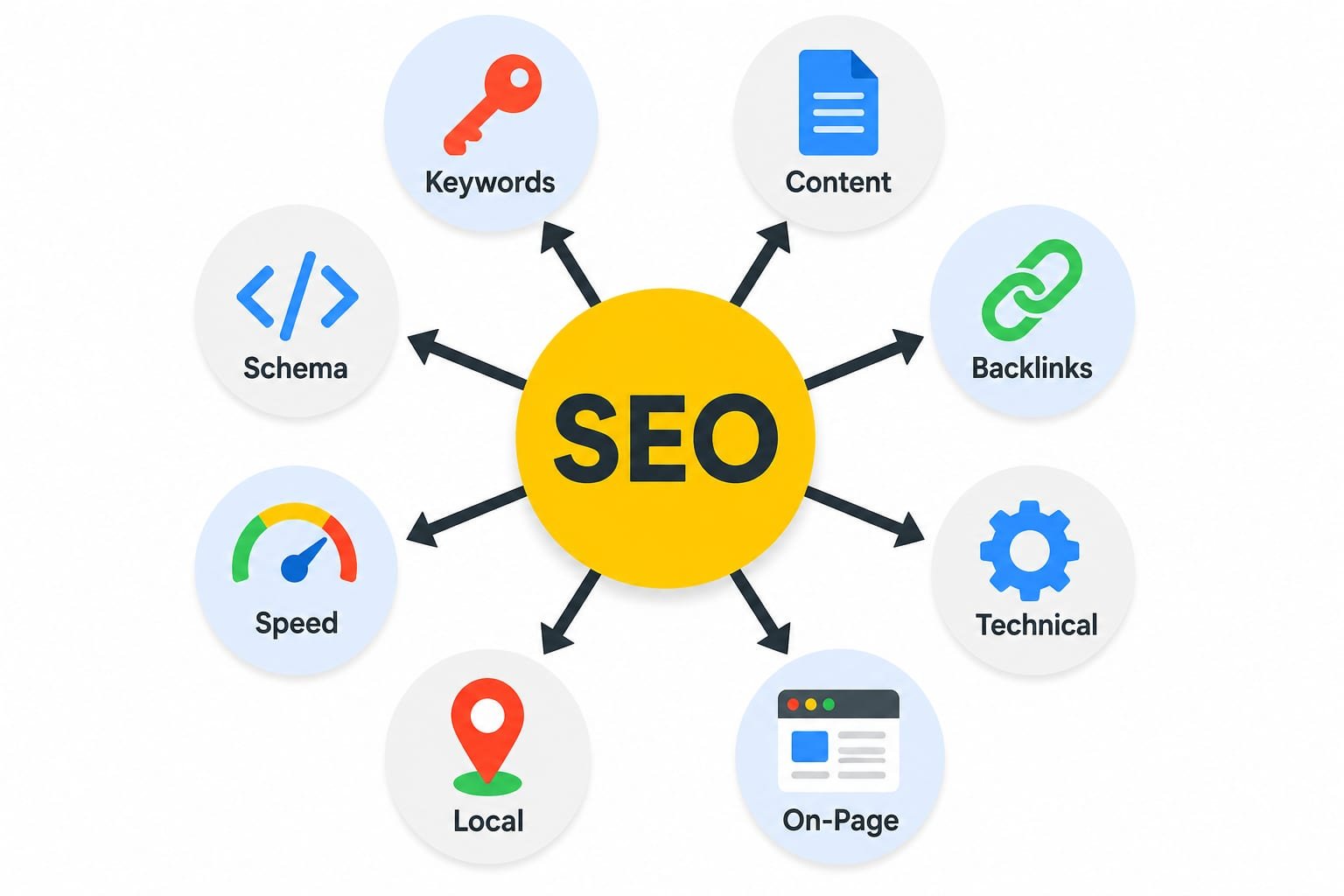
SEO services at Seorythm cover the three areas that decide whether a website earns search traffic that converts: technical health (crawling, indexing, rendering, page speed, site architecture), on-page work (keyword mapping, page briefs, rewrites, internal linking, structured data), and link acquisition (digital PR, editorial outreach, unlinked mention reclamation). The work starts with a two-week audit and a 90-day roadmap, then runs as a sprint against that roadmap with fortnightly reporting. Reporting tracks the pages we touched, their rankings and clicks, and the sales, enquiries, or sign-ups those pages produced, not a site-wide traffic total. You get a named strategist, a technical lead, and a link acquisition lead, and every deliverable is yours to keep. What is not included is anything we consider a scheme: private blog networks, mass AI content without a human editor, or promises about position one.
What you get
| Deliverable | Cadence | What it includes |
|---|---|---|
| Audit and 90-day roadmap | Weeks 1 to 3 | Technical crawl, content and keyword gap analysis, link profile review. Every issue gets an owner, effort estimate, and expected impact. |
| Technical fixes and specifications | Sprint, continuous | Tickets written for your developers, or fixes shipped by us on Astro, Next.js, WordPress, Webflow, and HubSpot. |
| Page briefs and rewrites | 4 to 8 pages per month | Briefs with target queries, outline, internal links, and citable answer blocks. Drafts written by us or your team, edited by us. |
| Link acquisition | Monthly target set in roadmap | Digital PR, editorial outreach, resource pages, unlinked mention reclamation. Full source list disclosed. See link building. |
| Structured data and internal linking | Sprint, per page | Organization, Service, Article, Person, and BreadcrumbList graphs; internal link graph maintained as data. |
| Reporting | Every two weeks, plus quarterly review | Pages touched, rankings, clicks, and conversions per page. A written summary you can forward to your board without editing. |
How the work is done
Audit first, always
We are an SEO company, not a general marketing agency, and every engagement starts with the two-week audit, even if you arrive with a recent one from another agency. We are not being precious about it. Audits from vendors who wanted the retainer tend to list problems that justify the retainer. Ours is priced so that walking away with it is a sensible outcome, and it forecasts what each fix is worth so you can rank the work by value rather than by how loud the tool that found it was.
Sequence by dependency, not by ease
The roadmap is ordered by what blocks what. Crawl and index problems come first, because a page Google cannot render will not rank no matter how good the copy is. On-page work comes second, because links pointing at weak pages waste the links. Link acquisition starts once the target pages are worth linking to. Quick wins are pulled forward when they are genuinely independent, but we do not let them jump the queue just because they make an early report look good.
This is where we differ from vendors who start with “content, content, content”. Publishing forty articles onto a site with a rendering problem or a broken canonical setup produces forty more pages with the same problem.
One graph for internal links and structured data
Internal links are maintained as a data file, not typed by hand into pages. That lets us audit which pages point where, spot orphans, and rewire the graph when the strategy changes. Structured data follows the same rule: one Organization node, one WebSite node, and per-page Service, Article, or Person nodes that reference each other by ID. It is unglamorous and it is the reason our sites validate cleanly the first time.
Who does the work
You get three named people: a strategist who owns the roadmap and the reporting, a technical SEO lead who writes or ships the fixes, and a link acquisition lead who runs outreach. Writers for on-page SEO work are drawn from a small bench and are named on every brief. Nobody on your account is anonymous, and nothing is outsourced to a marketplace without telling you. Businesses with physical locations add the local SEO layer; online stores add ecommerce SEO for templates, facets, and feeds; companies whose buyers ask AI assistants first add answer engine optimization for citations and prompt tracking.
You can read the full methodology for the reasoning behind each step, and the pricing page for what each stage costs and what drives the number. If you want to understand how agencies price this work in general before talking to us, start with how SEO agency pricing works.
What it costs

Fixed-price audit, then a monthly sprint or retainer fee
The audit is $2,800 fixed for sites up to 1,000 URLs. The 90-day sprint runs $4,800 to $7,400 a month and the retainer $2,300 to $4,900, depending on page volume, who ships the technical work, and whether links are in scope. Every figure is set 20% below the published price of the closest comparable large-agency service, and the comparison is on the pricing page.
What moves the number
- Number of pages briefed or rewritten per month
- Whether we ship technical fixes or specify them for your developers
- Link acquisition volume and tier
- Number of markets or languages (English only at present)
Who this is not for
- Companies with no product-market fit yet. SEO amplifies demand; it does not create it.
- Sites that need results inside 60 days to survive. Paid search is the right channel for that window.
- Businesses that want us to publish content without anyone on their side reviewing it for accuracy.
- Anyone who wants a guaranteed ranking. Nobody can honestly provide one.
Risks and how we manage them
| Risk | How we manage it |
|---|---|
| Algorithm updates change what works mid-programme. | We build for what Google has said it rewards for years (useful pages, sound technicals, earned links), so updates rarely reverse our work. When one hits, we re-run the audit on affected pages within a week. |
| Recommendations stall in your development backlog. | The roadmap includes effort estimates so you can plan capacity. If your team cannot ship, we can, on the platforms we support. |
| Content is produced faster than your experts can review it. | We cap page output at what your reviewers can handle and never publish without a named human sign-off from your side. |
| Traffic rises but pipeline does not. | Reporting is per page and tied to form fills or demo requests. If a page draws traffic that does not convert, we change the target queries rather than celebrate the chart. |
How long does SEO take to show results?
For an established site with no penalty history, technical fixes usually show in crawl and indexing data within two to six weeks, and in rankings for existing pages within one to three months. New pages targeting commercial terms typically take three to six months to settle, and competitive head terms can take longer than a year. Link acquisition compounds slowly: expect the first visible movement from links around month three. Those ranges assume the roadmap is actually shipped; the most common reason SEO stalls is that recommendations sit in a backlog. We set expectations in the audit for your specific site, including which items are quick wins and which are long bets, and the first quarterly review is where we check whether the forecast held. If it did not, we say why and what changes.
Questions buyers ask
Can we take the roadmap and run it in-house?
Yes. The audit and roadmap are SEO consulting products on their own (a ranked findings list, effort estimates, and a 90-day plan your team runs) and are priced so that this is a reasonable outcome. Some audit clients do exactly that and come back later for link acquisition or a specific project.
Do you sign a fixed-term contract?
The 90-day sprint is a fixed engagement. After that, retainers are month to month with 30 days notice. You keep every document, brief, and piece of code.
Will you use AI to write our content?
We use AI tools for research, outline drafts, and QA. Every published page is written or substantially rewritten by a named person and reviewed by your subject-matter expert. We do not publish mass-produced articles.
Is it worth paying for SEO services?
If your business already has customers and the pages that could bring more are sitting on page two, yes: the work compounds and stays yours. It is not worth it if you need revenue inside 60 days, if nobody on your side can review a page a week, or if the provider cannot tell you where its links come from. We say which applies to you in the audit.
Is SEO dead now that AI answers questions in search?
No, but it has changed shape. AI overviews and answer engines draw on the same things Google rewards: pages that answer a specific question clearly, named authors, accurate structured data, and sites they can crawl. Our on-page work is built for both, and this site is an example.
What do you need from us to start?
Access to Google Search Console and analytics, a technical contact, a subject-matter expert who can review one or two pages a week, and an honest conversation about what a lead is worth to you.
Start with the audit.
Two weeks, fixed price, and a prioritised list you can act on with or without us. If SEO is not the right channel for you, the audit will say so.