AI optimization (AIO): make every AI system describe your company accurately, and recommend it when it fits
A consistent, corroborated description of your company, products, and prices across every source an AI system draws on, so that assistants of any kind (search, chat, voice, shopping, in-app) state the right facts and name you where you belong.
For companies that have caught an assistant describing them wrongly, quoting an old price, or recommending a competitor for a job they do better, and for brands with several products whose facts have drifted across the web.
Updated
What is AI optimization (AIO)?
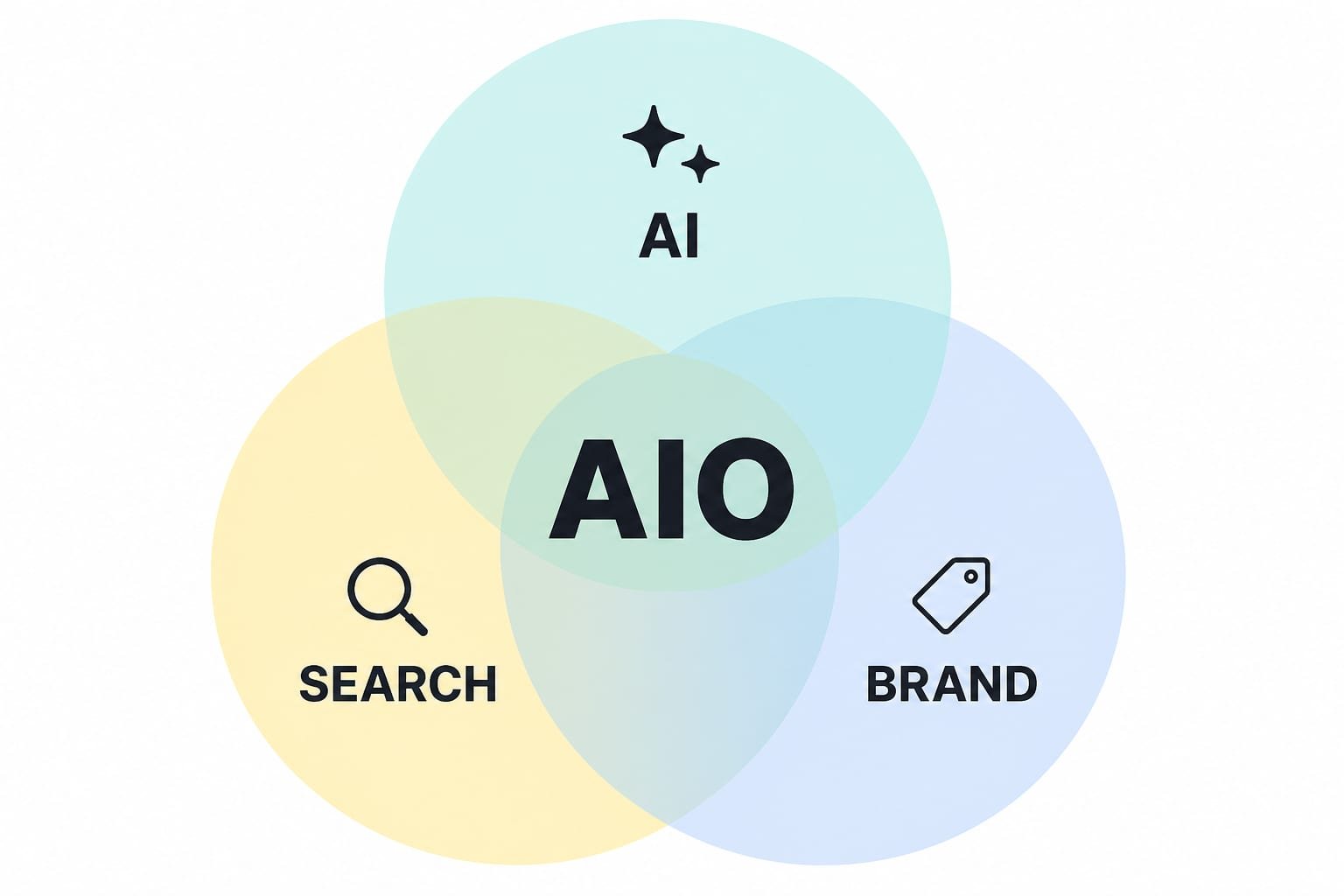
AI optimization (AIO) is the work of shaping how AI systems in general, not only search engines, understand and describe a company. Where SEO optimises pages for a ranking and AEO or GEO optimise passages for a citation, AIO optimises the entity: the set of facts about your company, products, people, and prices that a model can find, and how consistently they agree. That matters because assistants increasingly answer without a search at all, from what the model already knows and from the handful of sources it trusts for your category. If those sources disagree, the assistant hedges or gets it wrong. If they agree, it states your facts with confidence and recommends you when your product fits. The abbreviation has a second meaning in the SEO industry, where AIO is shorthand for Google's AI Overviews; optimising for those is covered on our generative engine optimization page. This page is about the broader discipline. At Seorythm, AIO covers an entity audit across the major assistants, a canonical fact set, structured data and knowledge-source alignment, corroborating mentions on the sources models trust, a corrections process, and a monthly record of what each assistant says.
What you get
| Deliverable | Cadence | What it includes |
|---|---|---|
| Entity audit | Weeks 1 to 2 | What ChatGPT, Gemini, Claude, Copilot, Perplexity, and Google's AI features currently say about your company, products, prices, people, and competitors, with each error traced to the source it came from. Knowledge panel and knowledge graph presence checked. |
| Canonical fact set | Month 1 | A single reviewed document of the facts you want every system to hold (names, descriptions, categories, prices, locations, people, dates, identifiers), signed off by you, and the source of truth for everything below. |
| Structured data and on-site alignment | Month 1 | Organization, Product, Offer, Person, and FAQ markup carrying the canonical facts, a plain about page and a corrections page stating them in prose, sameAs links to every profile, and llms.txt. |
| Knowledge-source alignment | Months 1 to 3 | The same facts, worded the same way, on the profiles and directories that models read for your category (business profiles, app stores, industry directories, review sites, Wikidata where eligible), with disambiguation where you share a name. |
| Corroborating mentions | Monthly target set in roadmap | Coverage on the publications and comparison sites each assistant draws on, stating the canonical facts. Handled with our link building team; mentions count with or without a link. |
| Monitoring and corrections | Monthly | The fact set re-checked against each assistant, errors logged with source and status, corrections filed through each platform's feedback route where one exists, and share of recommendation for a fixed prompt set tracked over time. |
How the work is done
Ask the assistants first
The audit begins with questions, not crawls. We ask ChatGPT, Gemini, Claude, Copilot, Perplexity, and Google’s AI features what your company does, what it sells, what it costs, where it is, who runs it, and how it compares with the alternatives, several times each, and record every answer. Then we trace each wrong or hedged answer back to the source that produced it: your own page that says it in prose but not in markup, a directory listing from three years ago, a press release about a product you discontinued, or a competitor with a similar name. The result is a list of facts, a list of errors, and for each error the place it came from. That list is the roadmap.
One fact set, signed by you
Before anything is published we write the canonical fact set: every name, description, category, price, location, person, date, and identifier you want every system to hold, in the exact wording you want it held. You review and sign it. It sounds bureaucratic and it is the step most companies have never done, which is why their facts have drifted. From here on, every piece of structured data, every profile, and every mention is checked against this document, and every change to it is dated.
Machine-readable on your site
Models can read prose, but they trust markup more, because it removes inference. We put the canonical facts into Organization, Product, Offer, and Person structured data, link every profile you control with sameAs, state the same facts in plain prose on the about page and a corrections page, and publish an llms.txt describing the site for AI crawlers. This is technical SEO work with an unusual audience: not a ranking algorithm, but a model deciding whether it knows enough to answer without hedging.
The same facts where the models read
An assistant that finds your fact stated identically on your site, your business profile, two industry directories, a review site, and a trade publication states it with confidence. One that finds three versions hedges. So the next stage is alignment: the same facts, worded the same way, on the sources models draw on for your category, with disambiguation wherever you share a name with something else. Where independent coverage is thin, our link building team earns it through digital PR and editorial outreach that states the facts we want held, whether or not a link comes with it. We do not edit Wikipedia for clients, post reviews, or create profiles under other names; each is a policy violation on the platform concerned and each would put the rest of the work at risk. If your company already meets Wikipedia’s notability bar, we will say so and point you to the proper route.
Corrections and the two clocks
Some answers change within weeks of the source changing, because the assistant retrieved them. Some are baked into the model and change only with the next model version. The monthly report separates the two, so you know which corrections have landed, which are waiting on a source, and which are waiting on a release, and we file corrections through each platform’s feedback route where one exists and log the outcome. Alongside accuracy we track share of recommendation: for a fixed set of prompts where your product is a fair answer, how often each assistant names you rather than a competitor. If the honest answer is that the assistant is right to name the competitor, the report says that too.
AIO is the entity layer of our AI search programme, next to answer engine optimization for conversational engines, generative engine optimization for Google’s AI features, and LLM optimization for long-horizon model knowledge. The differences are laid out in SEO vs AEO vs GEO vs AIO vs LLMO vs SXO. To see what the assistants say about you today, start with the audit, or see pricing.
What it costs

Included in the AI search programme, or a standalone AIO project plus monitoring
The entity audit is part of the $2,800 audit. Ongoing AIO work runs inside the sprint or retainer, or within the standalone AI search programme at $1,200 to $4,000 a month alongside AEO and GEO. Companies that need only the fact set, markup, and source alignment can buy that as a one-off project, quoted after the audit, with optional monthly monitoring.
What moves the number
- Number of products, locations, and people whose facts must be aligned
- Number of third-party sources that currently state something different
- Whether a name collision needs disambiguation
- Assistants covered and prompts tracked in monitoring
Who this is not for
- Companies that want an assistant to state something untrue or omit something material. The canonical fact set is checked against what is verifiable, and we will not file corrections that are not.
- Anyone who wants us to edit Wikipedia on their behalf, post reviews, or create sock-puppet profiles. All three are policy violations on those platforms and detectable.
- Buyers who expect a guaranteed recommendation for a given prompt. Model outputs vary, and no honest vendor promises one.
- Companies with no products, customers, or public footprint yet. There is nothing to corroborate.
Risks and how we manage them
| Risk | How we manage it |
|---|---|
| A correction is accepted by one platform and ignored by another. | Every fact is logged per assistant with its status. We work the sources each model actually relies on rather than the feedback form alone, and the monthly check shows where a correction has landed. |
| The canonical fact set goes stale as prices or products change. | The fact set is a living document with an owner on your side. Changes propagate through structured data first, then the third-party sources, in a defined order, and each change is dated. |
| Models update on their own schedule and a fix is slow to appear. | We separate retrieval-based answers (which change within weeks when the source changes) from parametric knowledge (which changes with the model version) and report each honestly, rather than claiming credit for one or blaming the other. |
| Optimising the entity without a product worth recommending. | AIO makes an assistant accurate, not generous. If the audit shows the assistant is right to recommend a competitor, we say so. |
Why does an AI assistant get facts about my company wrong?
Because it learned or retrieved them from sources that disagree, are out of date, or describe you vaguely, and it filled the gap with the nearest plausible thing. Four causes account for most cases. Your own site states a fact in prose but not in structured data, so the model has to infer it. A directory, review site, or old press release states a different fact and has never been corrected. Your company shares a name with something else and nothing disambiguates you. Or the fact simply is not published anywhere the model reads, so it guesses. The fix is the same in each case: publish the canonical fact plainly on your own site, mark it up so a machine can read it without inference, make the same fact appear on the third-party sources the model trusts for your category, and give the model something to cite. Then check monthly, because models update on their own schedule and a corrected source can take a cycle to be reflected.
Questions buyers ask
What does AIO stand for?
In this context, AI optimization: the work of making AI systems understand and describe a company accurately. In SEO shorthand it also means AI Overviews, Google's generated summaries at the top of results. The two are related, since the same facts feed both, but optimising for AI Overviews specifically is covered on our generative engine optimization page.
Is AIO different from AEO and GEO?
AEO and GEO are about being cited when an engine answers a question. AIO is about being described correctly and recommended appropriately by any AI system, including ones that never show a citation: a voice assistant, a shopping assistant, a support bot at a partner, an in-app helper. The work overlaps (structured data, consistent facts, corroborating mentions), which is why we sell all three inside one AI search programme, but the AIO audit looks at what the assistant says, not at which sources it shows.
How much does AI optimization cost?
The entity audit is included in our $2,800 audit. Ongoing work runs inside the sprint, the retainer, or the standalone AI search programme at $1,200 to $4,000 a month. The one-off fact set and alignment project is quoted after the audit; the drivers are the number of entities and the number of sources that disagree.
Can you fix what ChatGPT says about us?
Usually, over one to three months for retrieval-based answers, by correcting the sources it draws on and giving it a clear one to cite. Facts baked into a model's training update when the model does; we say which case you are in and do not promise a date for the second.
Do we need a Wikipedia page?
Not necessarily, and we will not write one for you; Wikipedia's conflict-of-interest rules exist for good reason. Wikidata eligibility, a knowledge panel, and consistent facts on the sources models trust for your category do most of the same work. If independent coverage of your company already meets Wikipedia's notability standard, we will tell you and point you to the proper process.
How do you measure AIO?
Two numbers, monthly. Fact accuracy: how many of the canonical facts each assistant states correctly, with each error logged to its source. Share of recommendation: for a fixed set of prompts where your product is a fair answer, how often each assistant names you, versus competitors.
Start with the audit.
Two weeks, fixed price, and a prioritised list you can act on with or without us. If SEO is not the right channel for you, the audit will say so.