Search experience optimization (SXO): turn the visit you earned into the enquiry you wanted
Each organic landing page matched to the intent that brings people to it, loading fast, readable on a phone, and leading to one clear next step, with reporting by leads and revenue per landing page rather than by rank.
For companies whose organic traffic is fine and whose organic leads are not, and for anyone who has ranked first for a term and wondered why nothing happened.
Updated
What is search experience optimization (SXO)?
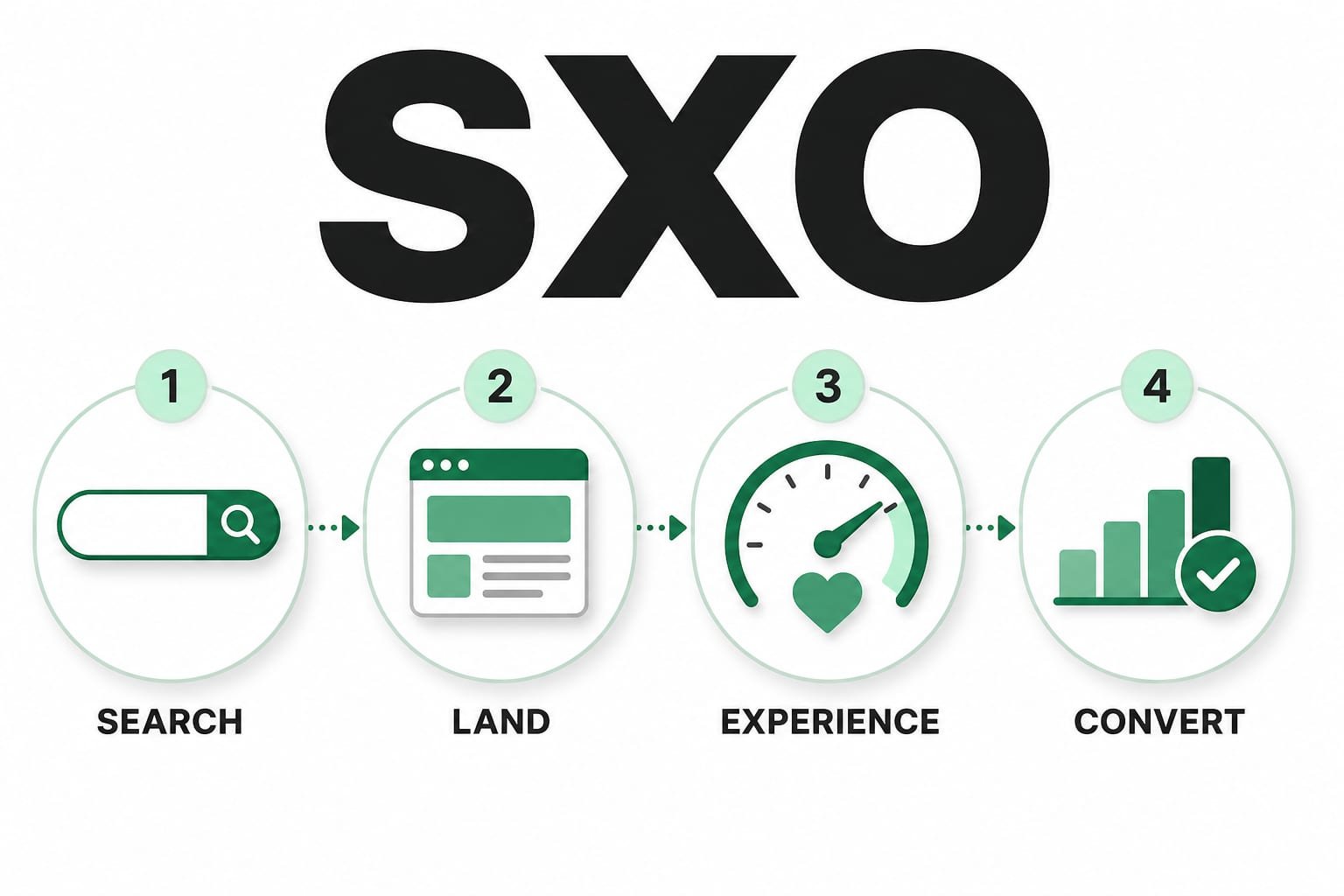
Search experience optimization (SXO) is SEO measured by what the visitor does after arriving. Classic SEO ends at the click: a page ranks, a person lands, the report records a session. SXO follows the person through the page and asks whether it answered the question they typed, loaded fast enough on the device they used, showed them the thing they came for without scrolling past three things they did not, and offered one clear next step. It combines three disciplines that are usually bought separately: search intent analysis (what does this query actually want), user experience (can they get it), and conversion optimization (do they take the next step). At Seorythm the SXO service starts by matching every organic landing page to the intent of the queries that send traffic to it, scores each page on speed, readability, and clarity of next step, and then fixes the pages in order of lost value. Reporting changes with it: instead of rankings and sessions, the monthly report shows leads and revenue per organic landing page, with each change dated so its effect is visible.
What you get
| Deliverable | Cadence | What it includes |
|---|---|---|
| Intent-to-page audit | Weeks 1 to 2 | Every organic landing page with the queries that send it traffic (from Search Console), the intent of each, whether the page serves it, and the leads and revenue it currently produces. Ranked by value lost. |
| Experience scoring | Weeks 1 to 2 | Each landing page scored on Core Web Vitals from field data, mobile readability, distance from arrival to the answer, and clarity of next step. Where analytics show it, scroll depth and exit points. |
| Page fixes, in value order | 4 to 8 pages per month | Answer moved to the top, intent-mismatched sections cut or split into their own page, price and proof made visible, one specific next step per page, speed and layout stability fixed at template level. |
| Conversion tests | 1 to 2 per month where traffic allows | Controlled tests of the next-step element, form length, proof placement, and headline on pages with enough traffic to read a result. Pages without enough traffic get the change directly and a before-and-after read. |
| Measurement setup | Month 1 | Lead and revenue attribution per organic landing page in your analytics and CRM, with the definitions agreed in writing so the monthly number cannot drift. |
| Reporting | Monthly | Leads and revenue per organic landing page, change since last month, each page change dated on the same chart, plus the rankings and sessions that still matter underneath. |
How the work is done
Read the queries before touching the page
Every organic landing page has a list of queries that send it traffic, and Search Console will show them. We read that list for each page and ask what the searcher wanted: a definition, a comparison, a price, a supplier, a fix. Then we ask whether the page gives it to them, and how far down. A page that ranks for a price query and hides the price under six paragraphs is losing the visit it earned. A page that ranks for three different intents is serving none of them and should probably be three pages, which is on-page SEO work with a clearer reason behind it. The audit records, for each page, the intent, the match, and the leads and revenue the page produces today. The gap between what it earns and what it should earn sets the order of work.
Score the experience the searcher had
The second pass scores what happened after the click. Speed and stability come from field data on Core Web Vitals, because a page that shifts or stalls on a phone loses people before they read a word, and fixing that is technical SEO at template level. Then readability on a phone, the distance from the top of the page to the thing the query asked for, and whether there is one clear next step or five competing ones. Where your analytics record scroll depth and exit points, we use them; where they do not, we set that up in month one so the next report can.
Fix in order of value lost
The fixes are unglamorous and they work: move the answer to the top, cut the introduction that restates the query, put the price on the page, show the proof next to the claim rather than in a separate section, replace the generic contact form with the specific next step this visitor wants, and remove the sections that serve a different intent. On ecommerce sites the same logic applies to category and product pages, and we apply it through the ecommerce SEO work. We do not use countdown timers, fake scarcity, or forms that hide their length; each converts once and costs you the review that follows.
Test where you can, measure where you cannot
Where a page has enough traffic to read a result within a few weeks, we run a controlled test of the change and tell you the minimum sample before starting. Most organic landing pages do not have that traffic, and pretending otherwise produces tests that never conclude. Those pages get the change directly, with a before-and-after read and a stated noise band, and the report says which method was used for each. Both are honest; only one of them is often sold.
Report the number the work was for
The monthly report leads with leads and revenue per organic landing page, with each change dated on the same chart so you can see what moved and when. Rankings and sessions sit underneath, because they still matter and because a change that lifts leads while dropping rank is something you should see and decide about. Attribution definitions are agreed in writing in month one, one system is named as the source for each number, and where the CRM and analytics disagree the report shows both.
SXO is the conversion layer of our SEO services programme, and it is the reason the programme is measured in leads rather than rank. Where it sits next to the AI search terms is set out in SEO vs AEO vs GEO vs AIO vs LLMO vs SXO. To see how much of your organic traffic is being lost on the page, start with the audit, or see pricing.
What it costs

Included in the sprint or retainer, or a standalone SXO project
The intent-to-page audit and experience scoring are part of the $2,800 audit. Page fixes and tests run inside the sprint ($4,800 to $7,400 a month) or retainer ($2,300 to $4,900). Companies that already have SEO covered can buy SXO as a standalone project for a defined set of landing pages, quoted after the audit.
What moves the number
- Number of organic landing pages carrying meaningful traffic
- Whether fixes are page-level or need template and development work
- Traffic volume, which decides whether changes can be tested or must be measured before and after
- State of your analytics and CRM attribution
Who this is not for
- Sites that do not yet have organic traffic to convert. SXO improves the return on visits you already earn; without them, start with SEO services.
- Companies that cannot make page changes. The audit produces a ranked list; if nobody can ship a change to a template, the list stays a list.
- Anyone who wants dark patterns. No fake countdowns, no hidden unsubscribe, no forms that pretend to be shorter than they are. They convert once and cost you the review that follows.
- Buyers who expect a conversion rate figure before the audit. We do not quote lift percentages we have not measured on your pages.
Risks and how we manage them
| Risk | How we manage it |
|---|---|
| Changes made for conversion hurt rankings. | Every change is made within the intent the page already ranks for, keeps the content the query needs, and is monitored for rank and traffic alongside leads. A change that lifts leads and drops rank is reported as both, and you decide. |
| Too little traffic to read a test. | We say so up front per page. Low-traffic pages get the change directly with a before-and-after read and a wider noise band, not a test that would take a year to conclude. |
| Attribution disagrees with the CRM. | Definitions are agreed in writing in month one, one system is named as the source of truth for each number, and the report shows both where they differ rather than picking the flattering one. |
| Fixing the experience of pages that should not exist. | The audit flags pages whose queries have no commercial value, or that cannibalise a better page, and recommends merging or retiring them before anyone polishes them. |
How is SXO different from SEO and CRO?
SEO brings the visit; conversion rate optimization (CRO) converts it; SXO is the discipline of doing both for the same page at the same time, because on organic landing pages they cannot be separated. The reason is intent. A CRO team testing a landing page usually assumes it knows why the visitor is there; on a paid landing page that is true, because the ad chose the audience. On an organic page the query chose the audience, and a page that ranks for three different intents will convert none of them well however the button is coloured. So SXO starts where CRO does not, by reading the queries that bring people to each page and deciding what that page is for. And it changes the page in ways an SEO team alone would not, because it is measuring leads rather than rank: moving the answer above the fold, cutting the introduction, adding the price, replacing a generic form with the specific next step. The measures differ too. SEO reports rank and sessions, CRO reports conversion rate, SXO reports leads and revenue per organic landing page, which is the number both of the others were supposed to move.
Questions buyers ask
What does SXO stand for?
Search experience optimization. It means optimising the whole experience of arriving from a search, from the query through the landing page to the next step, and measuring it by what the visitor did rather than by where the page ranked.
Is SXO replacing SEO?
No. SXO depends on SEO to bring the visit and on the same technical and on-page work to keep the page fast and relevant. What it replaces is the habit of reporting rank and sessions as if they were the goal. It is SEO with the report card changed.
How much does SXO cost?
The intent-to-page audit and experience scoring are included in our $2,800 audit. Ongoing fixes and tests run inside the sprint ($4,800 to $7,400 a month) or retainer ($2,300 to $4,900 a month). A standalone SXO project for a defined set of landing pages is quoted after the audit, and the drivers are the number of pages and whether the fixes need development work.
Do you do A/B testing?
Where a page has enough traffic to read a result inside a few weeks, yes, and we tell you the minimum sample before starting. Where it does not, we make the change and measure before and after with a stated noise band, which is honest about what a small page can tell you.
How does SXO relate to Core Web Vitals?
Core Web Vitals are one part of experience scoring. A slow or shifting page loses visitors before they read anything, so we fix them at template level as part of the work. But a fast page that answers the wrong question still converts nobody, which is why the intent audit comes first.
Does SXO help with AI search?
Indirectly, and in one direct way. The pages that convert best from organic search, with the answer at the top, a clear price, and specific proof, are the same pages generative engines prefer to cite. And as AI answers take the informational clicks, the visits that remain are more often from people ready to act, which makes the experience of the landing page matter more, not less.
Start with the audit.
Two weeks, fixed price, and a prioritised list you can act on with or without us. If SEO is not the right channel for you, the audit will say so.