On-page SEO that makes pages worth ranking, then makes them rank
Every commercial page mapped to the queries it should own, rewritten to answer them, and wired into the site so search engines and buyers both find it.
For any company whose product pages, category pages, service pages, or guides are indexed but sit on page two or three, or rank for queries that do not lead to a sale.
Updated
What is included in on-page SEO services?
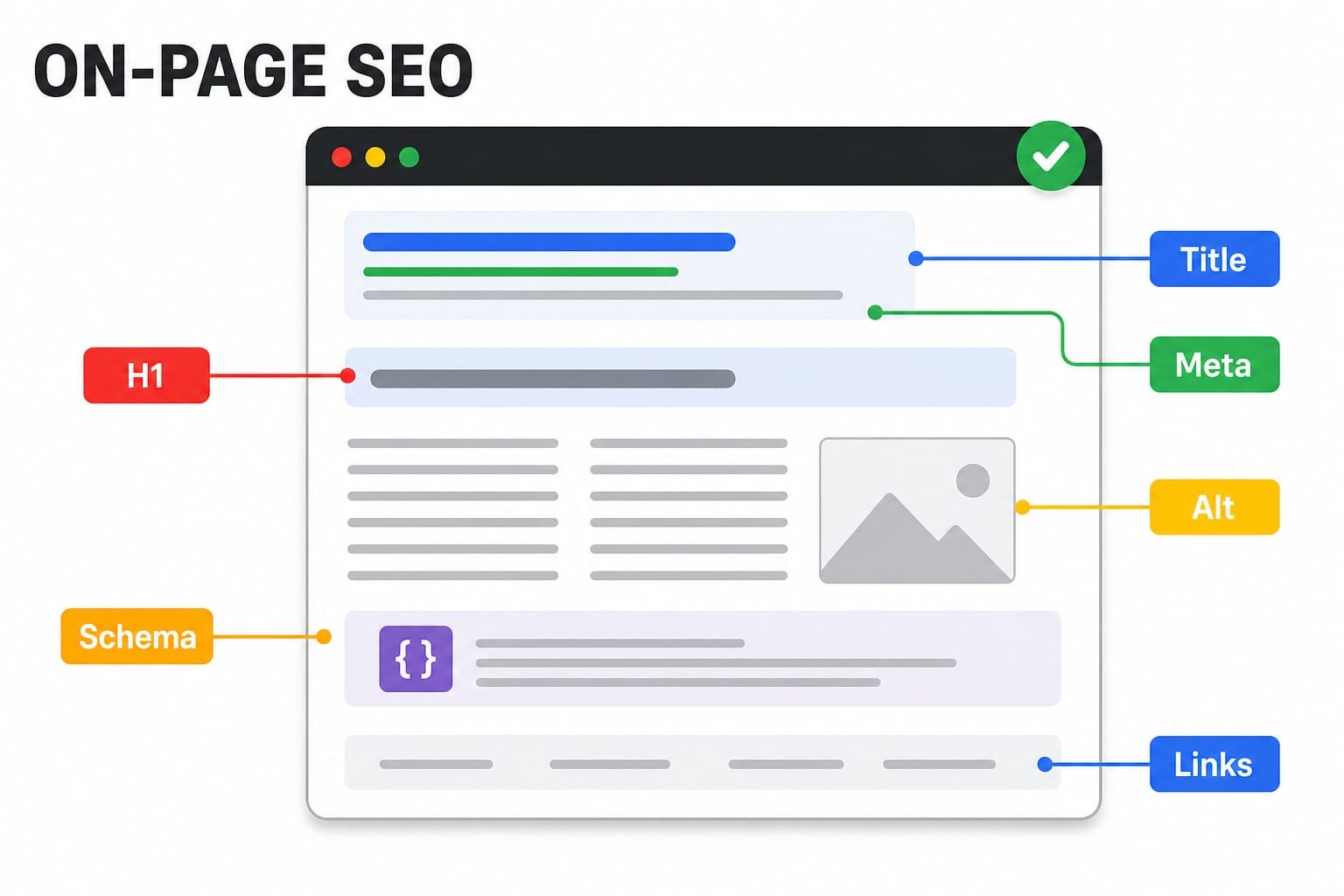
On-page SEO covers everything about an individual page that you control: which queries it targets, how the title, headings, and body answer them, how it links to and from other pages on your site, and how it is described to search engines through structured data. At Seorythm the service starts with a keyword map that assigns one primary intent to each page so that pages stop competing with each other. Each page then gets a brief (target queries, searcher questions to answer, outline, internal links, and a citable answer block), followed by a rewrite or a new draft, an edit pass by a named editor, review by your subject-matter expert, and publication with the correct title, meta description, canonical, and schema. Content SEO, meaning new guides and articles planned around a topic cluster, is part of this service. Off-page factors such as links are handled under link building.
What you get
| Deliverable | Cadence | What it includes |
|---|---|---|
| Keyword map | Weeks 1 to 2 | One primary query cluster per page, cannibalisation resolved, gaps identified. Maintained as a shared sheet for the engagement. |
| Page briefs | 4 to 8 per month | Target queries, searcher questions, outline, internal links in and out, answer blocks, schema types, and the expert who must review it. |
| Rewrites and new drafts | Matches brief cadence | Written by a named writer or by your team from our brief, edited by us, reviewed by your expert. Nothing publishes without both sign-offs. |
| Internal linking | Per page and quarterly graph review | Links added from and to each page based on the cluster graph. Orphans and over-linked pages fixed. |
| Structured data | Per page | Article, Service, Person, and BreadcrumbList nodes validated in the Rich Results Test before publication. |
| Page performance report | Every two weeks | Per-page rankings, clicks, and conversions for every page touched, compared with the four weeks before the change. |
How the work is done
One page, one intent
The keyword map is the foundation. Each page is assigned one primary query cluster and the searcher intent behind it. When two pages target the same intent, we pick one, consolidate the other into it, and redirect. This is unglamorous and it resolves more ranking problems than any writing technique, because Google will not rank two of your pages for the same query and will often pick the weaker one.
Briefs carry the information gain requirement
A brief lists the target queries, the questions a searcher would ask, and the outline. It also lists what the page must contain that competing pages do not: a decision rule, a number with a source, a failure mode, a “when not to” section. If we cannot name at least three such items, the page is not worth writing yet, and we go back to your team for the material. This requirement is what separates a page that ranks and converts from one that ranks briefly and is replaced, and it is the practical version of what Google describes in its guidance on creating helpful, reliable, people-first content.
Editing before expert review
Drafts go through a named editor before they reach your subject-matter expert. The editor checks structure, removes filler and stock phrasing, and marks every factual claim so your expert can check claims rather than proofread. Expert review is required for publication; we do not publish anything about your product that your team has not confirmed.
Titles, descriptions, and schema are part of the page, not an afterthought
Each published page ships with a title under 60 characters, a meta description between 140 and 160, a self-referencing canonical, internal links in both directions, and the schema types the page type calls for, validated before it goes live. We do not add FAQPage or HowTo markup: Google removed HowTo rich results and restricted FAQ rich results in August 2023 and retired FAQ rich results for all sites in May 2026, and marking up content for a result that no longer exists only adds maintenance. Each page is validated with the Rich Results Test before it goes live.
On-page work sits between technical SEO, which makes sure pages can be crawled and rendered, and link building, which brings authority to pages once they deserve it. It is included in our SEO services programme and available on its own. Start with a content audit if you are not sure which pages are underperforming, or see pricing.
What it costs

Monthly fee based on page volume
Priced by the number of pages briefed and rewritten per month and whether we or your team write the drafts, inside the sprint ($4,800 to $7,400 a month) or retainer ($2,300 to $4,900) bands on the pricing page. Structured data and internal linking are included for every page we touch.
What moves the number
- Pages per month
- Who writes the drafts (us or you)
- Whether new research or expert interviews are needed for the pages
Who this is not for
- Sites with unresolved crawl, indexing, or rendering problems. Fix those first; we will find them in the audit.
- Companies with nobody available to review pages for accuracy. We will not publish unreviewed claims about your product.
- Buyers who measure content by word count or publishing frequency.
- Programmatic pages generated from a template at scale. We can advise on it, but it is a different service.
Risks and how we manage them
| Risk | How we manage it |
|---|---|
| Rewrites lose rankings the page already had. | Every rewrite keeps the queries the page currently ranks for in scope, preserves the URL (we change a URL only when it is actively harmful, with a 301 and a record), and is compared with the prior four weeks. If a page drops, we revert within days and diagnose. |
| Pages compete with each other for the same query. | The keyword map assigns one primary intent per page. Where two pages overlap, one is consolidated or redirected, with the decision recorded. |
| Content reads as generic or AI-generated. | Briefs require information gain: specific decisions, numbers with sources, and trade-offs that only your team knows. Drafts are edited by a person and pass a written style check before review. |
| Your experts become the bottleneck. | We size the cadence to their review capacity and send pages in batches with a clear list of the claims that need checking, not the whole document. |
How do you decide which pages to work on first?
We rank pages by the gap between where they rank and where they could rank, multiplied by what a visitor from that query is worth. A page sitting at position 6 to 15 for a query that leads to sales or enquiries is the highest priority, because a modest improvement moves it into the positions that receive most clicks and the traffic converts. Pages already in the top three get maintenance rather than rewrites. Pages ranking for informational queries with no path to a sale are deprioritised unless they feed a cluster that supports a commercial page. New pages are created only when the keyword map shows a query with commercial intent that no existing page can honestly serve. This ordering usually means the first month is spent on pages you already have, which is less exciting than a content calendar but moves pipeline sooner.
Questions buyers ask
Do you write the content or do we?
Either. Some clients want us to write; others have writers and want briefs and editing. The price differs and both routes get the same editorial and expert review.
Is content SEO the same as on-page SEO?
Content SEO is the part of on-page work that plans and produces new pages around topic clusters. We treat it as part of this service rather than a separate one, because the brief, review, and linking process is identical.
How many pages should we expect per month?
Usually four to eight, depending on how much research each needs and how fast your reviewers can turn pages around. We would rather ship four good pages than twelve that nobody checked.
Will you optimise for AI search and answer engines too?
The on-page work is the foundation for both: question-form headings, self-contained answer blocks, named authors, and accurate structured data are what traditional search and AI answer systems draw on. Prompt tracking, entity consistency, and mention acquisition on top of that are the answer engine optimization service.
How much does on-page SEO cost?
Inside the 90-day sprint ($4,800 to $7,400 a month) or the retainer ($2,300 to $4,900), depending on how many pages we brief and rewrite each month and whether we or your team write the drafts. On page SEO services bought alone sit at the lower end of the retainer band. The audit that decides which pages to work on first is $2,800.
What is an example of on-page SEO?
Take a pricing page stuck on page two for "seo agency pricing". On-page work gives it a title in the buyer's words, an opening paragraph that answers the question in two sentences, a table of what moves the price, internal links from the service pages, and Offer structured data. Nothing off the page changes. Whatever the page gains from that is on-page SEO; links and authority are the other half.
Start with the audit.
Two weeks, fixed price, and a prioritised list you can act on with or without us. If SEO is not the right channel for you, the audit will say so.